Area Real Estate News & Market Trends

You’ll find our blog to be a wealth of information, covering everything from local market statistics and home values to community happenings. That’s because we care about the community and want to help you find your place in it. Please reach out if you have any questions at all. We’d love to talk with you!

July 24, 2026

Front Range Golf Communities: A Buyer's Guide from Castle Pines to The Broadmoor

Buyers who move to Colorado for the golf usually start in the wrong place. They find a course they love, then look for houses near it, and only later discover that the club is invitation-only, or that the home they liked backs to a tee box, or that "golf community" meant the course closed to non-members a decade ago.

The Front Range between Denver and Colorado Springs has some of the best golf in the country, and the access rules vary enormously from club to club. Here is the practical map, north to south.

Castle Pines: the marquee address

Castle Pines has three notable courses, and they are constantly confused with one another, including in real estate listings.

Castle Pines Golf Club opened in 1981, a Jack Nicklaus design inside the gates of The Village at Castle Pines. Ranked among the country's top 100 courses since 1987, it hosted the 2024 BMW Championship. The clubhouse was updated in 2020. Membership is invitation-only, and no home purchase creates a path to it.

The Country Club at Castle Pines opened in 1986, also Nicklaus, also inside the Village gates. Golf membership is capped at 395. It sits near 7,000 feet and includes a 20-acre practice facility and The Crags putting course, plus tennis, pickleball, fitness, and a pool with cabanas. For families where one person golfs and the rest want a club, this is usually the better fit.

The Ridge at Castle Pines North is a Tom Weiskopf design from the late 1990s, and critically, it is public. It sits on Castle Pines Parkway in the City of Castle Pines, west of I-25, not inside the Village.

That last distinction trips up a lot of people. If you read that "the Country Club at Castle Pines is a Tom Weiskopf course," two different clubs have been merged into one. The Country Club is Nicklaus and private, inside the Village. The Ridge is Weiskopf and public, in Castle Pines North.

Homes: Village properties run roughly $1.2M at entry to $8M+ for custom estates, with HOA dues around $3,000 to $5,000 per year that do not include golf. Near the public Ridge in Castle Pines North, established resale homes generally run $700,000 to $1.5 million, which is a far more attainable way to live minutes from good golf.

Castle Rock and Larkspur: the value play

The Castle Rock area has the best public golf density on the Front Range, which matters if you want to play frequently without an initiation fee.

Plum Creek Golf Course is an 18-hole public championship course at about 6,200 feet, running through ponderosa pines. Its par-3 12th is framed by roughly 10,000 railroad ties, and the par-3 17th plays over water.

Red Hawk Ridge is public, built into dramatic elevation changes with rolling terrain and long views.

The Golf Club at Bear Dance, just south in Larkspur, is public and widely considered one of Colorado's most demanding public courses.

Perry Park Country Club, also near Larkspur, is private and member-owned, set among red rock formations near Pike National Forest. It is one of the more distinctive settings in the state.

Homes: Castle Rock's Zillow Home Value Index was about $672,982 as of May 31, 2026, down roughly 2.1% year over year. Golf-adjacent homes carry a premium over that, but the entry point is dramatically lower than Castle Pines, and the public access means you can play without joining anything.

Colorado Springs: history and resort golf

The Club at Flying Horse in north Colorado Springs is a private club anchored by a Tom Weiskopf course, part of a resort and club community with lodging and full amenities. It has become the primary golf-community address on the north side of the Springs, and it is close to the I-25 corridor for anyone splitting time toward Denver.

The Broadmoor Golf Club is the historic one. The original course was a Donald Ross design that opened in 1918, with Robert Trent Jones adding eighteen holes in 1965. Today it plays as two championship courses, the East (par 72, 7,355 yards) and the West (par 71, 7,016 yards). A third Mountain Course closed permanently in 2015 after a landslide.

Access is resort and private, tied to The Broadmoor. The championship history is genuinely remarkable: U.S. Women's Opens in 1995 and 2011, U.S. Senior Opens in 2008, 2018, and 2025, and U.S. Amateurs in 1959 and 1967. Jack Nicklaus won his first major here, the 1959 U.S. Amateur, at nineteen. Annika Sörenstam won her first major here in 1995.

Homes: the Broadmoor area is one of Colorado Springs' most established luxury neighborhoods, with mature streets and significant architectural variety. Flying Horse skews newer, with more new construction and a more amenity-driven feel. They attract genuinely different buyers.

Public, private, or invitation: the question to settle first

Sort access before you shop for a house. The order matters.

Club Access
Castle Pines Golf Club Invitation-only
The Country Club at Castle Pines Private, golf capped at 395
The Ridge at Castle Pines North Public
Plum Creek, Red Hawk Ridge, Bear Dance Public
Perry Park Country Club Private, member-owned
The Club at Flying Horse Private
The Broadmoor Golf Club Resort / private

Buying a home does not include club membership at any of the private clubs above. Ask about waitlists, initiation structure, annual dues, and capital assessments before you commit to a house. I have watched buyers close expecting membership to follow and learn afterward that it does not work that way.

Does a golf course lot hold value?

More conditionally than agents usually admit.

Generally supportive of value: an unobstructed view down a fairway or across water, southern exposure, and real distance from tee boxes and greens.

Often a drag: proximity to a tee box, which means early morning noise. Position in a landing zone, which means errant balls and sometimes liability questions. Cart path frontage, which means traffic past your patio.

The premium for "on the course" is not uniform. A well-positioned lot commands real money. A poorly positioned one can be harder to sell than an interior lot at the same price. Walk the hole before you commit, ideally on a Saturday morning when play is heaviest.

Frequently asked questions

Can anyone play Castle Pines Golf Club?

No. It is invitation-only. For public play in Castle Pines, The Ridge at Castle Pines North is the option, and it is an excellent Tom Weiskopf design.

Is The Ridge at Castle Pines North public or private?

Public. It sits on Castle Pines Parkway in the City of Castle Pines, not inside the Village gates.

Who designed The Broadmoor golf courses?

Donald Ross designed the original course, which opened in 1918. Robert Trent Jones added eighteen holes in 1965. The club now plays as an East and a West course.

Does buying a home in a golf community include membership?

Almost never at the private clubs on the Front Range. Home purchase and club membership are separate transactions. Verify membership availability and cost before you buy.

Which Front Range golf community is most affordable?

The Castle Rock area, comfortably. It has the highest concentration of quality public courses and a Zillow Home Value Index around $672,982, compared with roughly $903,639 in Castle Pines.

Buying with golf in mind?

If golf is driving your move, the sequence matters: settle club access first, then shop for the house, then evaluate the specific lot. I cover the corridor from Colorado Springs through Castle Rock and Castle Pines to the south Denver metro, so I can compare these communities against each other rather than selling you the one I happen to know.

Browse current golf course homes, or contact me and I will lay out what is realistic on membership at each club and which course-side lots are actually worth the premium.

Want the community detail first? Read our Village at Castle Pines buyer's guide and the Castle Pines neighborhoods breakdown. Selling a golf course home? Get a free home value report.
Posted in Buying
July 20, 2026

Relocating to Douglas County, CO: The Out-of-State Buyer's Guide for 2026

Most of my out-of-state clients arrive with the same three-day plan: fly in Friday, see everything Saturday, decide by Sunday. It almost never works, because Douglas County is not one market. It is five or six distinct towns with different prices, different commutes, and genuinely different daily lives, spread across nearly 850 square miles.

This guide is meant to do the narrowing before you get on the plane, so your visit is spent confirming a decision instead of forming one.

Start with the map, not the listings

Douglas County sits directly south of Denver. The county runs from the Denver Tech Center down past Castle Rock toward Colorado Springs, with I-25 as the spine. Everything east of I-25 flattens toward the plains. Everything west climbs into foothills and pine.

That geography drives almost everything: price, tree cover, commute, and how the seasons feel.

The towns, compared on the numbers

All figures below are the Zillow Home Value Index, a modeled estimate of typical home value across the whole housing stock. It is the cleanest way to compare towns against each other, because median sale price moves around depending on which price band happened to sell that month.

Town Home Value Index YoY change Data as of Character
Castle Pines ~$903,639 -1.8% 6/30/26 Wooded, upscale, gated options
Lone Tree ~$895,306 -3.3% 5/31/26 Closest to DTC, light rail, medical hub
Highlands Ranch ~$711,007 -3.1% 5/31/26 Large master-planned, amenity-rich
Parker ~$687,773 -2.5% 6/30/26 Walkable downtown, family-oriented
Castle Rock ~$672,982 -2.1% 5/31/26 Growing, new construction, outlets

Two clear tiers. Castle Pines and Lone Tree sit near $900,000. Highlands Ranch, Parker, and Castle Rock cluster around $670,000 to $710,000.

Values are modestly down across all five, in a tight band of roughly 2% to 3%. This is useful context if you are selling in a hotter market elsewhere and expecting a bidding war here.

But read the pace alongside the price, because the two tell different stories. Highlands Ranch posted the second-largest decline in the group and the fastest pace, going under contract in about 8 days. Parker and Castle Rock ran about 19 days. That combination, falling values with very quick absorption, means sellers are meeting the market rather than buyers disappearing. Correctly priced homes still move fast. Overpriced ones sit and then reduce.

The practical translation for you: you will have negotiating room on homes that have been listed a while, and almost none on a well-priced new listing.

Matching a town to your life

If you commute to the Denver Tech Center: Lone Tree first, then Highlands Ranch or Castle Pines. Lone Tree has RTD light rail at Lincoln Station and the Sky Ridge medical campus.

If you fly frequently: Parker. E-470 gets you to DIA in roughly 30 to 40 minutes, notably better than Castle Rock or Castle Pines.

If you want trees, privacy, and larger lots: Castle Pines. Elevation between 6,200 and 6,800 feet, mature ponderosa pine, and the guard-gated Village at Castle Pines if privacy is the priority.

If you want a walkable downtown: Parker, comfortably. Castle Rock second.

If you want new construction: Castle Rock has the most, and The Canyons in Castle Pines offers a large Shea Homes community with collections from the mid-$700,000s into the $1.6 million range.

If you want land or horses: look west and south to Sedalia, Larkspur, and Franktown. See our Douglas County acreage guide.

Five things that surprise out-of-state buyers

1. Metro district taxes. This is the big one, and it is nearly invisible until you see a tax bill. Most newer Colorado neighborhoods were built by metropolitan districts that borrowed to install infrastructure and repay that debt through a property tax mill levy. Two identical $1 million homes in different Castle Pines communities can differ by several hundred dollars a month in taxes. Read our Castle Pines HOA and metro district guide before you tour, not after.

2. Water is a separate question outside town. On acreage, you are on a well, and the well permit type governs whether you can legally water livestock or irrigate. Ask early.

3. Wildfire insurance. In the wooded western parts of the county, get an insurance quote during your inspection period. Availability and premiums have shifted, and it is a bad thing to discover late.

4. Elevation is real. Castle Pines sits above 6,200 feet. Expect a couple of weeks of adjustment, drier air, and stronger sun. It also means cooler summer evenings than Denver.

5. Schools are excellent but boundaries move. Douglas County School District is strong throughout, but attendance boundaries have been redrawn as the county has grown. Verify the current boundary for a specific address with the district directly. Listing sheets and school-rating sites are frequently out of date.

A realistic relocation timeline

8 to 12 weeks out: narrow to two towns. Get pre-approved with a lender licensed in Colorado. Decide whether you are buying before selling, and if so, how you are bridging.

4 to 6 weeks out: plan a visit of at least three days. Spend a weekday morning driving your actual commute at the actual hour. This single step changes more minds than anything else.

During the visit: see homes in both towns at your price point, plus one above and one below. Walk each downtown. Eat dinner in each place on a weeknight.

Under contract: budget 30 to 45 days to close. Order inspection immediately, and if you are looking at acreage, add time for well and septic testing.

What today's market means for you

Softer values with quick absorption is a favorable pattern for a relocating buyer. You have room to negotiate, particularly on homes that have been listed a while, but you cannot dawdle on a well-priced new listing.

The thing to avoid is the compressed weekend decision. Douglas County towns look similar in photos and feel completely different in person, and the difference between a good relocation and a regretted one is usually two extra days of looking.

Frequently asked questions

What is the best town in Douglas County, CO to move to?

It depends on your commute and budget. Lone Tree is best for Tech Center commuters and transit. Parker is best for a walkable downtown and airport access. Castle Pines is best for trees, privacy, and upscale housing. Castle Rock and Highlands Ranch offer the most house for the money.

How much do homes cost in Douglas County, CO?

In mid-2026, the Zillow Home Value Index ranged from about $672,982 in Castle Rock to about $903,639 in Castle Pines. Values were down roughly 2% to 3% year over year across the county.

What are metro district taxes in Colorado?

A metropolitan district is a local government that funds neighborhood infrastructure through bonds and repays them through a property tax mill levy. Levies vary widely by community and are usually the largest tax difference between two similarly priced homes.

Is Douglas County a good place to live?

It consistently ranks among Colorado's strongest counties for schools, safety, and household income, with extensive trail systems and quick access to both Denver and the mountains. The main tradeoffs are cost and car dependence outside Parker's downtown and Lone Tree's transit corridor.

Planning a move to Douglas County?

I work with relocating buyers regularly, and the most useful thing I do is usually the least glamorous: helping you rule places out before you spend a weekend on them.

Contact me and I will put together a relocation package with neighborhood comparisons, current listings in your price range, and a driving itinerary for your visit. You can also browse homes across Douglas County or read our town guides for Castle Pines, Castle Rock, and Parker.

Posted in Buying
July 15, 2026

Living in Parker, CO: The 2026 Guide for Buyers & Newcomers

Parker gets described as "the family town" of Douglas County so often that the phrase has stopped meaning much. What people are actually reacting to is more specific than that: Parker is one of the few places in the south metro that has a real downtown, and that changes how the whole town feels.

If you are weighing Parker against Castle Pines, Castle Rock, or Highlands Ranch, here is an honest look at what you get and what you give up.

What homes cost in Parker in 2026

As of June 30, 2026, Parker's Zillow Home Value Index sat at about $687,773, down roughly 2.5% year over year. The median sale price was near $681,500, and homes were going under contract in about 19 days.

Those two figures measure different things, which is worth knowing whenever you compare markets. The Home Value Index is a modeled estimate of a typical home's value across the whole housing stock. The median sale price reflects only what actually sold that month, which skews toward whatever price band was most active. In Parker they happen to sit close together. In Castle Pines they do not.

Two things worth pulling out of those numbers.

Parker is meaningfully more attainable than Castle Pines. Castle Pines' Home Value Index was about $903,639 over the same period, with a median sale price just over $1 million. Compare like to like: on the Home Value Index, Parker sits roughly $216,000 below Castle Pines. On median sale price, the gap is closer to $350,000.

The market is still moving quickly. Nineteen days to pending is a fast market by any historical standard, even with values off a couple of percent. That combination, softer prices but quick absorption, means well-priced homes still sell promptly while overpriced ones sit.

For comparison across the south metro in mid-2026, all figures Zillow Home Value Index:

Town Home Value Index YoY Data as of
Castle Pines ~$903,639 -1.8% 6/30/2026
Lone Tree ~$895,306 -3.3% 5/31/2026
Highlands Ranch ~$711,007 -3.1% 5/31/2026
Parker ~$687,773 -2.5% 6/30/2026
Castle Rock ~$672,982 -2.1% 5/31/2026

Parker and Castle Rock sit at essentially the same price point. Castle Pines and Lone Tree occupy a tier above. Every market in the group is modestly down from a year ago, in a fairly tight band of roughly 2% to 3%.

The downtown is the differentiator

Most south metro suburbs were master-planned around arterial roads and shopping centers. Parker grew around a historic Mainstreet, and the town has invested in keeping it a real destination rather than a themed one.

You get walkable blocks of independent restaurants and shops, a genuine town center rather than a lifestyle center, the PACE Center performing arts venue, and community events that draw the whole town, most notably Parker Days each summer.

The practical effect is that Parker has a there there. Residents meet downtown. That is harder to find in Highlands Ranch or Castle Pines, both of which are lovely and neither of which has a walkable core in the same way.

Outdoor life

Parker sits on the Cherry Creek Trail, which runs north toward Cherry Creek State Park and eventually into Denver, making it genuinely useful for cycling and running rather than just a neighborhood path. The town maintains an extensive park system and multiple recreation centers, and the terrain is gently rolling plains rather than the pine-covered ridges you get in Castle Pines.

That is a real tradeoff. Parker has more sky and more open space. Castle Pines has more trees and more elevation. Drive both before you decide which you want to look at every morning.

Schools

Parker is served by Douglas County School District, consistently one of Colorado's stronger districts, along with several charter and private options. Attendance boundaries in Parker have been adjusted as the town has grown, so verify the current boundary for any specific address directly with the district rather than relying on a listing sheet or a school-rating site. Boundaries are the single most commonly out-of-date detail in real estate listings.

Commuting

  • Denver Tech Center: typically 20 to 30 minutes via Parker Road or E-470, longer at peak.
  • Downtown Denver: roughly 35 to 50 minutes depending on route and time of day.
  • DIA: usually 30 to 40 minutes via E-470, which is one of Parker's underrated advantages over Castle Rock or Castle Pines.
  • Light rail: Parker does not have a station within town. The nearest RTD light rail access is at Lincoln Station in Lone Tree, which many Parker commuters drive to.

If a train commute matters to you, that last point deserves weight. Lone Tree and parts of Highlands Ranch have better transit access.

Who Parker fits

Parker is a strong fit if: you want a walkable downtown, a family-oriented community, good schools, more house for the money than Castle Pines, and easy airport access.

Look elsewhere if: you want mature pine forest and large lots, in which case look at Castle Pines or the acreage communities of Sedalia, Larkspur, and Franktown. Or if you need light rail, in which case look at Lone Tree.

A note on buying here right now

Values are modestly below last year while homes still go under contract in under three weeks. That is an unusual and fairly favorable combination for a buyer: you have some negotiating leverage on price, but you cannot be slow when the right house appears.

For sellers, the same data says pricing correctly at launch matters more than it has in years. Homes priced to the market move in weeks. Homes priced to last year's market accumulate days on market and end up taking a price reduction anyway.

Frequently asked questions

Is Parker, CO a good place to live?

For families and buyers who want a walkable downtown with suburban housing, it is one of the better options in the south metro. It offers a real town center, strong Douglas County schools, extensive trails, and a median sale price roughly $350,000 below Castle Pines.

How much does a house cost in Parker, CO?

As of June 2026 the median sale price was around $681,500, and Parker's Zillow Home Value Index was about $687,773, down roughly 2.5% from a year earlier.

Is Parker or Castle Rock better?

They are priced almost identically, around $680,000 to $690,000. Parker has the stronger walkable downtown and better airport access. Castle Rock has more new construction, the outlets, and easier I-25 access south. It comes down to which downtown you prefer and which direction you drive most.

How far is Parker from Denver?

Roughly 25 miles to downtown Denver, typically 35 to 50 minutes by car. The Denver Tech Center is closer, usually 20 to 30 minutes.

Thinking about a move to Parker?

The best way to know whether Parker fits is to spend a Saturday morning downtown and then drive two or three neighborhoods at different price points. I am happy to map that out for you.

Browse current Parker homes for sale, or contact me and I will build a search filtered by neighborhood, school boundary, and price. Comparing Parker to other Douglas County towns? Read our guides to living in Castle Pines and living in Castle Rock. Selling a Parker home? Get a free home value report.

Posted in Buying, Parker
July 10, 2026

Castle Pines HOA Fees & Metro Districts: What You Actually Pay, Community by Community

Here is a scenario I have watched play out more than once. A buyer tours two Castle Pines homes on the same day. Both are listed at $1 million. Both are about the same size. The buyer likes the second one slightly better and assumes the monthly cost is a wash.

It is not a wash. Depending on which community each home sits in, the difference in carrying cost can be several hundred dollars a month, every month, forever. That gap has nothing to do with the house and everything to do with two things nobody puts in the listing photos: the HOA and the metro district.

Almost nobody explains this clearly before you are under contract. So let me.

HOA and metro district are not the same thing

This is the core confusion, and getting it straight makes everything else make sense.

An HOA is a private nonprofit corporation. It collects dues from members. It maintains common areas, amenities, and landscaping, enforces covenants, and funds reserves for future replacement. You pay it directly, usually monthly, quarterly, or annually. If you do not pay, the HOA can place a lien.

A metropolitan district is a unit of local government. It levies property taxes. It was created to finance the infrastructure that made your neighborhood possible in the first place: roads, water and sewer lines, storm drainage, street lighting, parks. You pay it as a line item on your county property tax bill, not as a separate invoice. If you do not pay, it becomes a tax lien.

The practical difference for a buyer: HOA dues show up in your lender's monthly calculation as an obvious number. Metro district taxes hide inside your property tax escrow, where most buyers never break them out. That is exactly why they surprise people.

Many Castle Pines communities have both.

Why metro districts vary so much

Every metro district carries a mill levy, and the mill levy largely reflects how much infrastructure debt the district is still paying off. Newer communities built recently borrowed heavily to install everything from scratch, and they are early in repayment. Older communities have paid theirs down.

The spread within Douglas County is dramatic. For reference, here are reported district mill levies:

  • Castle Pines North Metropolitan District: about 3.5 mills as of 2024, down from roughly 19 mills after the district transferred parks and recreation responsibilities to the City of Castle Pines in 2023.
  • Canyons Metropolitan District No. 2: about 71.73 mills.
  • Highlands Ranch: about 10.1 mills.
  • Elsewhere in Douglas County, newer districts run much higher. Founders Village in Castle Rock has been reported near 94.6 mills and Sterling Ranch's district No. 3 near 95.5 mills combined.

Those numbers are not a criticism of newer communities. The Canyons has genuinely exceptional amenities, and someone had to pay to build them. But you should know what you are signing up for.

What that difference actually costs

Colorado's property tax math changed, and most online explanations are out of date. Under HB24B-1001, Douglas County applies two different residential assessment rates for tax years 2024 through 2027:

  • 7.05% for school district levies
  • 6.8% for local government levies, after subtracting 10% of actual value, capped at the first $700,000

A metro district is a local government levy, so the 6.8% rate applies. Note that the reduction is the lesser of 10% of actual value or $70,000, so a $600,000 home subtracts $60,000 while a $1,000,000 home subtracts the $70,000 cap.

One caveat worth stating plainly: the statute includes a growth trigger. If statewide actual value growth exceeds 5% from 2024 to 2025, the local government rate steps down further rather than holding at 6.8%. Given the softening across the south metro, the 6.8% branch appears to be the operative one, but this is determined by the state, not by inference. The figures here reflect tax year 2026 as published by the Douglas County Assessor at the time of writing.

For a $1,000,000 Castle Pines home, the local government assessed value works out to roughly $63,240. Applying the district levies above:

  • In a Canyons metro district (about 71.73 mills): roughly $4,536 per year for that line item
  • In Castle Pines North (about 3.5 mills): roughly $221 per year for that line item

That is a difference of about $4,315 a year, or roughly $360 a month, on two homes at the same price.

Now the essential caveat, because this number is easy to misread. Those figures are the metro district line item only. They are not your total property tax bill. Every Castle Pines homeowner also pays Douglas County, Douglas County School District, South Metro Fire, the library district, drainage, and the City of Castle Pines' own levies, which include 4.5 mills for law enforcement passed to the Douglas County Sheriff and 12 mills for parks, recreation, trails, and open space.

A realistic total annual property tax bill on a $1 million Castle Pines home lands somewhere in the $6,000 to $7,000+ range depending on district. The metro district is not the whole bill. It is simply the piece that varies most between one neighborhood and the next, which is why it deserves your attention.

Mill levies are also reset annually and vary by the specific parcel, and district figures published at different times are not always directly comparable. Treat every figure above as illustrative and verify your actual property on the Douglas County Assessor's property search, which lists the exact taxing authorities for that address. I do this for clients before they write an offer, and I am happy to do it for you whether or not we work together.

HOA dues by Castle Pines community

Approximate 2026 ranges. Confirm exact figures with the current HOA disclosure for any specific property.

The Village at Castle Pines: roughly $3,000 to $5,000 per year. Covers gate staffing at five entrances, security patrols, private trail maintenance, parks, and the Canyon Club. Golf memberships at Castle Pines Golf Club and The Country Club at Castle Pines are entirely separate and not included.

The Canyons: a Shea Homes master-planned community with its own structure funding the Canyon House clubhouse, resort-style pool, The Exchange coffee house, more than 15 miles of trails, pickleball, and event lawn. Confirm current dues with the builder or HOA, and note that the metro district levy discussed above is on top of HOA dues, not instead of them.

Castle Pines North / City of Castle Pines: the most variable category, because "Castle Pines North" is many sub-neighborhoods, including Buffalo Ridge, Hidden Pointe, The Retreat, Canterbury Park, Bramble Ridge, Daniel's Ridge, and Whisper Canyon. Dues range from modest to moderate depending on what the association maintains. The upside here is the metro district levy is now very low following the 2023 transfer.

Castle Valley: a newer development with its own association and district structure. As with any newer community, ask specifically about the district's debt position.

The three questions to ask before you write an offer

  1. What is the total monthly cost of ownership, not just the mortgage? Principal, interest, taxes, insurance, HOA dues, and any separate club or amenity fees.
  2. What is the metro district's mill levy on this exact parcel, and what is its debt schedule? A district early in a long repayment is a different proposition than one nearly paid off.
  3. What does the HOA actually maintain, and what is in reserves? An underfunded reserve fund is a future special assessment.

Colorado requires sellers to provide HOA documents. Read them. Specifically read the reserve study and recent meeting minutes, which is where planned assessments show up first.

Frequently asked questions

How much are HOA fees in Castle Pines, CO?

It depends heavily on the community. The Village at Castle Pines runs roughly $3,000 to $5,000 per year. Castle Pines North neighborhoods vary widely by sub-association. The Canyons has its own structure funding an unusually large amenity package.

What is a metro district and why does Castle Pines have them?

A metropolitan district is a local government that issues bonds to build neighborhood infrastructure, then repays that debt through a property tax mill levy. Most newer Colorado communities, including much of Castle Pines, were built this way.

Why are property taxes higher in The Canyons than in Castle Pines North?

Because the Canyons metro district is still repaying the debt that funded its infrastructure and amenities, at a reported levy near 71.73 mills, while Castle Pines North's district dropped to roughly 3.5 mills after transferring parks and recreation to the city in 2023.

Do metro district fees ever go away?

They can decline substantially as bonds are repaid, as Castle Pines North demonstrates. But repayment schedules often run decades, and districts can issue new debt. Ask for the current schedule rather than assuming.

Know your real monthly number before you fall in love with a house

The difference between two Castle Pines homes at the same price can be several hundred dollars a month. That is worth ten minutes of research before you are emotionally committed.

Before my clients write an offer, I pull the actual taxing authorities and HOA disclosures for the specific property so the monthly number is real, not estimated. Contact me and I will run that for any Castle Pines home you are considering, whether or not you are working with me.

New to the area? Start with our guide to living in Castle Pines and the Castle Pines neighborhoods breakdown. Selling? Get a free home value report.


About the author: Max Ferguson is the founder of Max Realty Co., a licensed Colorado real estate brokerage serving Castle Pines, Castle Rock, Parker, and the Colorado Springs corridor. More about Max.

Published July 2026. This article is general information for prospective buyers and sellers, not tax, legal, or financial advice. Colorado assessment rates and metro district mill levies are set annually and vary by parcel; the figures here are illustrative and reflect published rates at the time of writing. Verify the numbers for any specific property with the Douglas County Assessor and consult a qualified tax professional before relying on them in a purchase decision.

Posted in Buying, Castle Pines
July 6, 2026

Castle Rock Real Estate Market Update: Summer 2026 Trends & Forecast

Castle Rock, CO real estate market update summer 2026 - prices, days on market and inventory

Whether you're planning to buy, sell, or just keep an eye on your home's value, here's where the Castle Rock, CO real estate market stands in the summer of 2026 — prices, how fast homes are moving, who has the upper hand, and what the rest of the year may hold. (Market data shifts month to month, so treat these as a snapshot; for live numbers, use the tools linked below.)

Castle Rock home prices right now

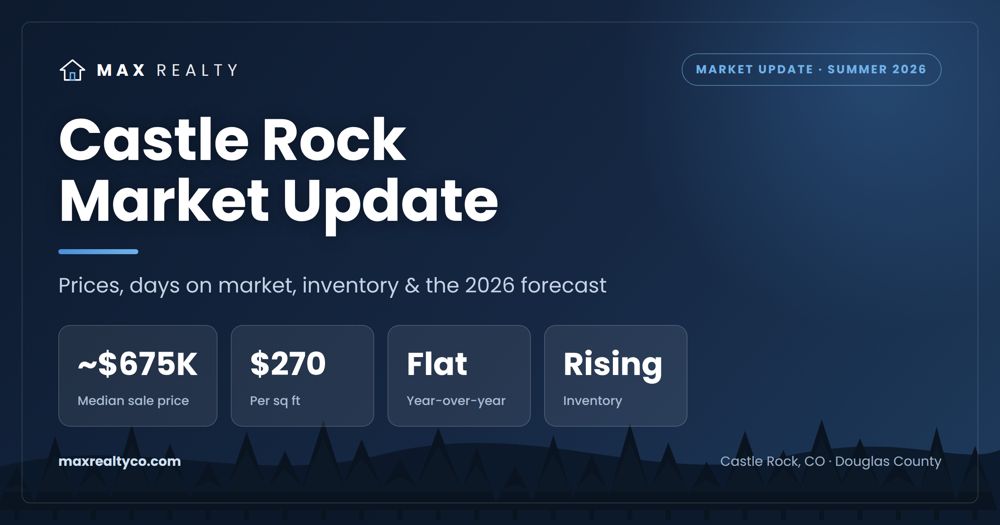
As of mid-2026, the median sale price in Castle Rock is roughly $650,000 to $700,000 (with list prices running a bit higher, around $720K–$780K), at about $260–$280 per square foot. Prices vary widely by neighborhood, from attainable homes in Crystal Valley and Founders Village to larger properties in The Meadows. The headline: prices are essentially flat to slightly down year over year, a clear shift from the double-digit gains of a few years ago.

How fast are homes selling?

The pace has cooled. Well-priced homes are still going under contract in roughly three to four weeks, but overall days on market have lengthened compared with a year ago, and a large share of listings — close to half — have taken at least one price cut. Homes are generally closing at about 97–99% of list price, so buyers are negotiating modest discounts off asking.

More inventory, more choice

Inventory has climbed significantly, with active listings up meaningfully year over year and months of supply rising toward a balanced level. For buyers, that means more selection and more breathing room than at any point in the past few years. For sellers, it means more competition — so standing out on price and presentation is essential.

Is it a buyer's or seller's market?

Castle Rock is best described as a balancing market that's tilting toward buyers in summer 2026. Homes still sell relatively close to asking, but rising inventory, longer days on market, frequent price cuts, and flat-to-slightly-declining prices all point to growing buyer leverage. In practical terms: sellers no longer command the bidding wars of 2021–2022, and buyers finally have room to be selective and negotiate — while well-priced, move-in-ready homes still sell quickly.

2026 forecast and outlook

Looking ahead, the expectation for Castle Rock and the south Denver metro is moderate, steady conditions rather than dramatic swings:

  • Forecasts point to modest price growth for Castle Rock in 2026 — roughly in the low-single-digit percent range — not a decline or a crash.
  • Rising inventory across the metro should keep bringing the market toward balance and giving buyers more options.
  • Mortgage rates are expected to settle near 6%, and existing-home sales are projected to pick up as the market finds a more traditional rhythm.
  • Underlying demand stays supported by Castle Rock's schools, parks, downtown, and easy access to Denver and the DTC.

As always, mortgage rates remain the wild card — shifts in either direction can quickly change buyer urgency.

What this means if you're buying

You have more leverage than buyers have had in years: more inventory to choose from, more time to decide, and real room to negotiate on price and terms. Getting pre-approved and moving decisively still matters for the best homes — but the pressure of 2021-style bidding wars has eased. Browse current Castle Rock listings, or if you're new to the area, start with our guide to living in Castle Rock and our neighborhood breakdown.

What this means if you're selling

Homes are still selling — but 2021 is over. Pricing accurately from day one, preparing your home to show well, and marketing it aggressively are what separate a strong, timely sale from a listing that lingers as inventory rises. See our Castle Rock seller's guide, and check your home's current value with a free home value estimate.

Frequently asked questions about the Castle Rock market

Is it a buyer's or seller's market in Castle Rock?

It's best described as a balancing market tilting toward buyers. Homes still sell relatively close to asking, but rising inventory, longer days on market, and frequent price cuts give buyers more leverage than they've had in years.

Are home prices dropping in Castle Rock?

Not meaningfully. As of mid-2026 prices are essentially flat to slightly down year over year, and forecasts point to modest growth in 2026 rather than a significant decline.

Is 2026 a good time to buy in Castle Rock?

Buyers currently have more inventory and more negotiating room than in recent years. Whether it's the right time for you comes down to your goals, budget, and mortgage rates — worth talking through with a local agent.

Get current, hyper-local numbers

Want the latest data for your exact neighborhood or price range? Pull a live Castle Rock market report, or reach out to me directly for a personalized read on the market and what it means for your buying or selling plans.

June 30, 2026

Castle Pines Real Estate Market Update: Summer 2026 Trends & Forecast

Castle Pines, CO real estate market update summer 2026 - prices, days on market and inventory

Whether you're planning to buy, sell, or just keep an eye on your home's value, here's where the Castle Pines, CO real estate market stands in the summer of 2026—the prices, how fast homes are moving, who has the upper hand, and what the rest of the year may hold. (Market data shifts month to month, so treat these as a snapshot; for live numbers, use the tools linked below.)

Castle Pines home prices right now

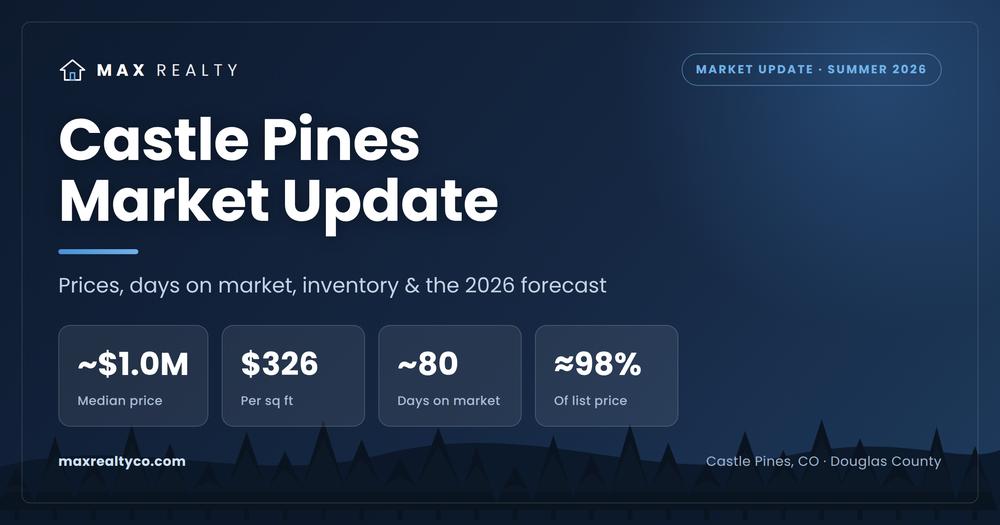
Castle Pines remains a luxury market. As of mid-2026, typical home values sit in the range of roughly $900,000 to just over $1 million, at around $326 per square foot—with meaningful variation by neighborhood, from Castle Pines North resales to gated Village estates. The headline: prices are essentially flat to slightly down year over year, off roughly 2% on Zillow's Home Value Index, a clear shift from the double-digit appreciation of a few years ago.

How fast are homes selling?

The pace has cooled noticeably. Median days on market have risen to around 80—up sharply from roughly 50 a year earlier—which is one of the clearest signs the market has loosened. That said, there's nuance: sharply priced, well-presented homes are still going under contract in a matter of weeks, while overpriced listings are the ones sitting and racking up those longer averages. Homes are generally closing at about 98% of list price, meaning buyers are negotiating modest discounts off asking.

More inventory, more choice

Inventory has been climbing, with roughly 170–180+ homes on the market in recent months. For buyers, that means more selection and more breathing room than at any point in the past few years. For sellers, it means more competition—so standing out on price and presentation is essential.

Is it a buyer's or seller's market?

Castle Pines is best described as a balancing market. By some measures it's still technically a mild seller's market—homes sell relatively close to asking—but rising inventory, longer days on market, and flat-to-slightly-declining prices all point to growing buyer leverage. In practical terms: sellers no longer hold all the cards, and buyers finally have room to be selective and negotiate, while genuinely great homes at the right price still move quickly.

2026 forecast and outlook

Looking ahead, the expectation for Douglas County and the south Denver metro is moderate, steady conditions rather than dramatic swings:

  • Forecasts point to modest, steady price movement in Douglas County through 2026—a slowdown from prior boom years, not a crash.
  • Rising inventory across the metro should continue bringing the market toward balance and giving buyers more options.
  • Underlying demand stays supported by Castle Pines' top-rated schools, DTC and Denver job access, and continued relocation into south Denver.

As always, mortgage rates remain the wild card—shifts in either direction can quickly change buyer urgency and demand.

What this means if you're buying

You have more leverage than buyers have had in years: more inventory to choose from, more time to make decisions, and room to negotiate on price and terms. Getting pre-approved and moving decisively still matters for the best homes—but the pressure of 2021-style bidding wars has eased. Browse current Castle Pines listings or new to the area? Start with our guide to living in Castle Pines and our neighborhood breakdown.

What this means if you're selling

Homes are still selling—but 2021 is over. Pricing accurately from day one, preparing your home to show beautifully, and marketing it aggressively are what separate a strong, timely sale from a listing that lingers. See our Castle Pines seller's guide, and check your home's current value with a free home value estimate.

Frequently asked questions about the Castle Pines market

Is it a buyer's or seller's market in Castle Pines?

It's best described as a balancing market. Homes still sell relatively close to asking (a mild seller's-market signal), but rising inventory, longer days on market, and flat-to-slightly-declining prices give buyers more leverage than they've had in years.

Are home prices dropping in Castle Pines?

Not sharply. As of mid-2026 prices are roughly flat to slightly down year over year, off about 2%, and forecasts for Douglas County point to moderate, steady conditions rather than a significant decline.

Is 2026 a good time to buy in Castle Pines?

Buyers currently have more inventory and more negotiating room than in recent years. Whether it's the right time for you comes down to your goals, budget, and mortgage rates—worth talking through with a local agent.

Get current, hyper-local numbers

Want the latest data for your exact neighborhood or price range? Pull a live Castle Pines market report, or reach out to me directly for a personalized read on the market and what it means for your buying or selling plans.

June 24, 2026

The Village at Castle Pines: A Buyer's Guide to Colorado's Premier Gated Community

There is a specific moment that happens with almost every buyer touring The Village at Castle Pines for the first time. They pass through the gate, the road curves, the pines close in, and the Denver metro simply disappears. Twenty-five minutes from the Tech Center and it feels like a different state.

That feeling is what people buy here. But the Village is also the most misunderstood address in the south metro, and buyers routinely arrive with wrong assumptions about the gates, the golf, and what the dues actually cover. Here is the honest version.

What the Village actually is

The Village at Castle Pines is a guard-gated community of roughly 1,800 custom and estate homes spread across about 2,800 acres, sitting between 6,200 and 6,800 feet of elevation. It is a separate, unincorporated community from the City of Castle Pines, which is why locals distinguish between "the Village" and "Castle Pines North."

Five staffed entry gates control access, with security patrols inside. More than a dozen miles of private trails run through the community, along with several parks and the Canyon Club, which offers fitness, pools, and tennis.

The density is the point. On 2,800 acres you would fit several thousand suburban homes. There are 1,800 here, most on half an acre to several acres, many backing to open space.

What it costs in 2026

Approximate ranges as of mid-2026:

  • Entry-level Village homes: roughly $1.2M to $1.8M. Often 1990s construction needing updating.
  • Updated estates: roughly $1.8M to $3M. The heart of the market.
  • Custom trophy properties: $5M to $8M and beyond, on premium view lots.

HOA dues: roughly $3,000 to $5,000 per year. Golf club memberships are entirely separate and are not included.

For context, Castle Pines as a whole had a Zillow Home Value Index of about $903,639 as of June 30, 2026, down roughly 1.8% year over year, against a median sale price of about $1,033,000. Those two figures are 14% apart because they measure different things: the index models typical value across all homes, while the median reflects only what actually sold. The Village trades meaningfully above both, because the product is fundamentally different from the rest of the city.

The golf question, answered properly

This is where buyers get the most bad information, including from other agents. Let me be precise.

There are two private Jack Nicklaus courses inside the Village gates:

Castle Pines Golf Club (opened 1981) is invitation-only, has been ranked among the country's top 100 courses since 1987, and hosted the 2024 BMW Championship. The clubhouse was updated in 2020 and the club maintains on-site cottages.

The Country Club at Castle Pines (opened 1986) caps golf membership at 395 members. Beyond golf it offers tennis, pickleball, a fitness center, a pool with cabanas, hot tub and fire pits, a 20-acre practice facility, and The Crags putting course.

And a point of frequent confusion worth clearing up: The Ridge at Castle Pines North is a different course entirely. It is a public Tom Weiskopf design from the late 1990s, located in the City of Castle Pines on Castle Pines Parkway, not inside the Village gates. If you see it described as a private club inside the Village, that is incorrect.

The critical buyer fact: buying a home in the Village does not include or guarantee membership at either private club. Membership is a separate process with separate costs, and in the case of Castle Pines Golf Club, it is by invitation. If club access is a primary reason you are buying here, investigate membership availability and cost before you write an offer, not after closing.

Custom build versus resale

The Village has a limited number of remaining homesites, and buyers weighing a custom build against a resale should think about three things.

Time. A custom home here is typically a two-year-plus process from lot purchase through certificate of occupancy, including design review. The community's architectural standards are genuinely strict, which protects your value but lengthens your timeline.

Cost certainty. Resale gives you a known number. Custom gives you exactly what you want at a number that is difficult to fix precisely at the outset.

The current market favors resale buyers. With days on market extended across Castle Pines and price reductions common, there is more negotiating room on existing Village homes than there has been in several years. That calculus has shifted since 2022.

Who the Village is genuinely right for

It fits you if: you want privacy, mature trees, real acreage, controlled access, and a country-club-adjacent lifestyle, and you value seclusion over walkability.

It probably does not fit you if: you want to walk to coffee and dinner, you want new construction with a modern open plan at a lower price point, or you want resort amenities included in your dues. For those buyers, The Canyons on the east side of I-25 is usually the better answer, and it is a genuinely excellent community.

Also worth knowing: Village homes sit within Douglas County School District, in the Rock Canyon feeder. Buffalo Ridge and Timber Trail elementary schools serve Castle Pines area students, feeding Rocky Heights Middle School and Rock Canyon High School.

What to check before you buy in the Village

  • The specific HOA dues and what they cover for your property. They vary within the community.
  • The metro district on your parcel. Property tax bills in Castle Pines vary substantially by district, and it is the largest swing factor between two similarly priced homes. See our Castle Pines HOA and fee guide.
  • Architectural review requirements if you plan any exterior changes, including landscaping.
  • Club membership status and transferability, if that matters to you.
  • Well and water service for the small number of properties not on district water.

Frequently asked questions

Do you have to be a golf club member to live in The Village at Castle Pines?

No. Membership at Castle Pines Golf Club and The Country Club at Castle Pines is entirely separate from home ownership. You can live in the Village without belonging to either club.

How much are HOA dues in The Village at Castle Pines?

Roughly $3,000 to $5,000 per year depending on the property. Golf memberships are separate and not included in dues.

Is The Village at Castle Pines the same as the City of Castle Pines?

No. The Village is a separate guard-gated community. The City of Castle Pines, often called Castle Pines North, is west of I-25 and has more attainable resale homes, generally in the $700,000 to $1.5 million range.

What is the cheapest home in The Village at Castle Pines?

Entry-level Village homes generally start around $1.2 million, typically 1990s construction that has not been updated.

See the Village for yourself

Photos do not convey what the lot sizes and tree cover actually feel like here, and the difference between two homes at the same price can be enormous depending on lot, view, and orientation.

Browse current Village at Castle Pines homes for sale, or contact me for a private tour and a candid conversation about club memberships and which streets hold value best. Thinking about selling a Village home? Get a free home value report to see where you stand in today's market.

Posted in Castle Pines
June 18, 2026

Horse Property & Acreage in Douglas County: Sedalia, Larkspur & Franktown

Most buyers who call me about acreage in Douglas County start the conversation the same way: they have been looking at pretty listing photos of barns and pastures, and they have no idea what questions to ask. That is understandable. Buying five acres with a well and a septic system has almost nothing in common with buying a house in a subdivision, and the things that will cost you money later are almost never visible in the photos.

Sedalia, Larkspur, and Franktown are where most of that inventory sits. Here is what the market looks like right now and what actually matters when you buy out here.

What acreage in Douglas County costs in 2026

Horse property is a small, slow, high-value market, and it behaves very differently from the tract-home market ten minutes east.

In Sedalia in mid-2026, there were roughly 19 listed horse properties with a median list price near $1.7 million, ranging from under $250,000 for raw or small parcels to more than $3.7 million for full equestrian estates. Average days on market ran about 105 days.

That last number is the one to internalize. Acreage does not move like a Castle Pines resale. The buyer pool is smaller and more specific, which cuts both ways:

  • If you are buying: you generally have room to negotiate, time to do real due diligence, and far less competition than you would face on a $700,000 home in Parker.
  • If you are selling: pricing and presentation matter enormously, and "wait for the market to catch up" is a much more expensive strategy than it is in town.

Larkspur and Franktown follow a similar pattern, with Larkspur skewing toward wooded, higher-elevation parcels and Franktown offering more open, gently rolling land closer to Parker and Castle Rock.

The three towns, honestly compared

Sedalia sits about 24 miles from downtown Denver, tucked where the plains meet the foothills. It has the shortest commute of the three to the Denver Tech Center and the best access to Highway 85 and C-470. Parcels tend to be dramatic, with rock outcroppings and pine, and prices reflect that scenery. Best for buyers who want genuine seclusion without giving up a workable Denver commute.

Larkspur is further south along I-25, higher, and more heavily wooded. It is the most rural-feeling of the three and generally the most affordable per acre. The tradeoff is distance from services and, in some areas, more serious wildfire exposure to plan around. Best for buyers who want land and quiet and are willing to drive for groceries.

Franktown sits at the junction of Highways 83 and 86, east of Castle Rock. The terrain opens up, the parcels are often flatter and more usable for horses, and you are close to both Parker and Castle Rock. Best for buyers who want functional pasture and convenience over dramatic topography.

What to check before you write an offer

This is the part that separates a good acreage purchase from an expensive lesson.

Zoning and animal density. Do not assume land is "zoned for horses" because the listing says so. Douglas County zoning governs how many animals you can keep, what structures you can build, and whether you can run a boarding or lesson operation. A common rule of thumb is roughly 2.5 acres per horse, but the county's actual requirements and any subdivision covenants control. Verify the specific parcel before you go under contract, not after.

The well. This is the single biggest variable. You need to know the well permit type, because Colorado water law limits what a given permit allows. Some permits cover household use only. Some allow livestock watering and limited irrigation. A well that legally cannot water your horses is a serious problem on a horse property. Ask for the permit, the well completion report, recent production test results, and water quality testing.

The septic system. Get the permit history, the tank size, the last pumping date, and a use permit inspection. Douglas County requires an inspection at transfer. Replacing a failed system can run well into five figures.

Access and easements. Confirm whether the driveway crosses someone else's land, who is responsible for maintaining a shared road, and whether that agreement is recorded. Unrecorded handshake road agreements between neighbors are common out here and they do not survive a sale.

Fencing and outbuildings. Check whether barns, run-in sheds, and arenas were permitted. Unpermitted structures can complicate financing, insurance, and resale.

Wildfire and insurance. In wooded parts of Larkspur and western Sedalia, get an insurance quote before your inspection deadline expires. Premiums and availability have shifted meaningfully, and finding out late is a bad surprise.

Utilities and internet. Propane instead of natural gas is common. Confirm broadband options if anyone in the household works from home.

Financing acreage is different

Two things catch buyers off guard.

Lenders often treat properties above a certain acreage, or with significant outbuilding value, differently than standard residential. Appraisals can be harder because comparable sales are scarce and may be miles away. Build extra time into your contract for appraisal and give your lender the full picture up front.

If the property has income-producing agricultural use, its property tax treatment may differ from standard residential. That can be a meaningful annual difference, so ask what the current classification is and whether your intended use preserves it.

Is acreage still a good buy right now?

The wider south metro market has softened modestly. Values in Castle Rock, Parker, and Highlands Ranch are running a couple of percent below where they were a year ago, and days on market are up across the board. Acreage has followed the same direction, with the added feature that it was never a fast market to begin with.

For a buyer, that combination is favorable. Longer market times mean sellers are more willing to negotiate on price, on repairs, and on the extended timelines that acreage due diligence genuinely requires.

For a seller, it means the days of listing high and waiting are over. Correct pricing at launch is doing most of the work right now.

If you are weighing acreage against staying in town, it is worth reading our guide to living in Castle Pines and the current Castle Pines market update to see the tradeoff clearly.

Frequently asked questions

How many acres do you need per horse in Douglas County?

A common planning guideline is about 2.5 acres per horse, though it depends on whether you are supplementing with feed. Douglas County zoning and any applicable covenants set the actual limit for a specific parcel, so verify with the county before you buy.

Do horse properties in Sedalia have wells or city water?

Almost all rural acreage in Sedalia, Larkspur, and Franktown is on a private well and septic system. The well permit type matters, because some permits do not allow livestock watering or irrigation.

How much does horse property cost in Sedalia, CO?

In mid-2026 the median list price for Sedalia horse properties was around $1.7 million, with the overall range running from under $250,000 for smaller or raw parcels to over $3.7 million for full equestrian estates.

How long does acreage take to sell in Douglas County?

Considerably longer than in-town homes. Sedalia horse properties averaged around 105 days on market in mid-2026, compared to roughly three weeks for a typical suburban listing nearby.

Looking at acreage in Douglas County?

Acreage rewards patience and punishes assumptions. I walk clients through well permits, septic records, zoning, and access easements before we are emotionally committed to a property, which is the only time that review is actually useful.

Browse current Douglas County homes and land for sale, or contact me and I will set up a search filtered by acreage, zoning, and outbuildings. Selling acreage? Start with a free home value report and we will talk about how to price land correctly in a slower market.

Posted in Buying
June 11, 2026

How to Sell Your Home in Castle Rock, CO: A 2026 Seller’s Guide

Selling your home in Castle Rock, CO - 2026 seller guide from Max Realty

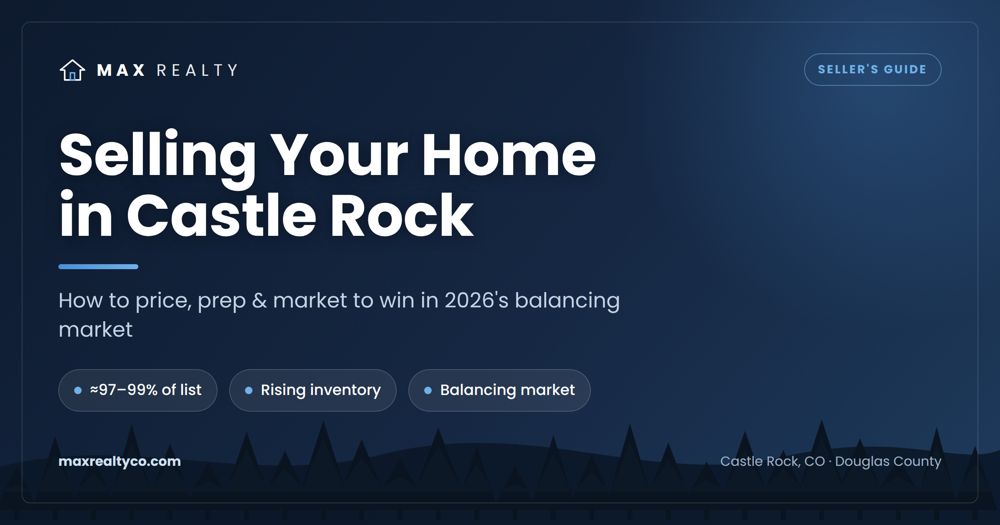
Selling a home in Castle Rock, CO in 2026 takes more strategy than it did during the frenzy of a few years ago. Inventory is up, homes are taking longer to sell, and buyers have regained real negotiating power — but well-prepared, well-priced Castle Rock homes are still selling at strong prices. Here's how to sell yours the right way this year.

First, understand today's Castle Rock market

As of mid-2026, the Castle Rock market has shifted from a seller's market toward balanced — and in some measures, toward buyers. A few signals to know before you list:

  • Prices are essentially flat year over year, with a median sale price in the ~$650K–$700K range.
  • Inventory has climbed sharply — active listings are up meaningfully from a year ago, giving buyers more choice.
  • Homes are taking longer to sell, and a large share of listings have taken at least one price cut — a classic sign that overpricing is being punished.
  • Well-priced homes still sell close to asking (roughly 97–99% of list), typically going under contract in a few weeks.

The takeaway: pricing discipline and presentation matter more than ever. For the latest numbers, see our Castle Rock market update.

1. Price it right from day one

In a market with rising inventory, overpricing is the single most costly mistake. Your strongest activity comes in the first two weeks, while your listing is fresh. Price too high and you miss that window — then you're chasing the market down with price cuts that signal something's wrong and often net you less than if you'd priced correctly from the start. A precise price, based on recent, truly comparable sales in your specific Castle Rock neighborhood, is what wins.

2. Prepare and stage your home

With more competition on the market, presentation is what makes buyers choose your home over the one down the street. Before you list:

  • Handle obvious repairs and consider a pre-listing inspection to avoid surprises.
  • Focus on high-ROI updates: fresh neutral paint, updated lighting, clean flooring, and current kitchens and bathrooms.
  • Declutter and depersonalize so buyers can picture themselves there — staging often pays for itself.
  • Maximize curb appeal, especially on view lots and larger yards common in Castle Rock.

3. Market it aggressively

A sign in the yard isn't enough when buyers have options. The homes that sell fastest are marketed hardest:

  • Professional photography and video (and drone where the lot or views warrant it).
  • Full syndication across the MLS and major portals, where nearly all buyers start.
  • Targeted digital marketing to reach relocating professionals and move-up buyers around Denver and the DTC.
  • Well-run showings and open houses that highlight your neighborhood's amenities — parks, trails, schools, and downtown.

If you're in a newer community like The Terrain or Crystal Valley, remember your home may be competing with builder inventory, so pricing and presentation have to account for that.

4. Time your sale strategically

Spring and early summer bring the most active buyers along the Front Range, but well-qualified buyers shop year-round in Castle Rock — and lighter competition in fall and winter can work in your favor. With inventory elevated, the right timing depends on your goals, your neighborhood, and current conditions, which is worth mapping out with a local agent before you set a date.

5. Choose a local Castle Rock expert

Castle Rock is a nuanced market where pricing dynamics differ from The Meadows to Founders Village to Crystal Valley, and where nearby new construction can affect your value. An agent who truly knows these neighborhoods — not just "the Denver metro" — will price and position your home far more effectively in today's conditions.

Frequently asked questions about selling in Castle Rock

Is it a good time to sell a home in Castle Rock?

Homes are still selling, but the market has balanced and tilted toward buyers, so pricing and preparation matter more than they did in 2021–2022. Well-priced, well-presented homes continue to sell at strong prices.

Are homes in Castle Rock selling below asking?

On average, homes are closing around 97–99% of list price, and a large share of listings have taken at least one price cut — which is exactly why pricing correctly from day one is so important.

How long does it take to sell a home in Castle Rock?

Sharply priced, move-in-ready homes are still going under contract in a few weeks, while overpriced listings can sit for a month or more as inventory rises.

What's your Castle Rock home worth?

The first step to a successful sale is knowing your home's true value in today's market. Start with a free, instant home value estimate, then let's refine it with a detailed, neighborhood-specific analysis. Want to understand what drives value here first? Read What's My Castle Rock Home Worth? When you're ready, reach out for a no-pressure conversation about selling.

Posted in Castle Rock, Selling
June 4, 2026

How to Sell Your Home in Castle Pines, CO: A 2026 Seller's Guide

Selling your home in Castle Pines, CO - 2026 seller guide from Max Realty

Selling a home in Castle Pines, CO in 2026 is a different game than it was two or three years ago. The bidding-war frenzy has cooled into a more balanced market, which means strategy—pricing, preparation, and marketing—matters more than ever. Do it well and well-priced Castle Pines homes still sell for strong prices. Get it wrong and your listing can sit. Here's how to sell your Castle Pines home the right way this year.

First, understand today's Castle Pines market

As of mid-2026, the Castle Pines market has shifted from the red-hot seller's market of 2021–2022 toward balance. A few signals to know before you list:

  • Prices are essentially flat to slightly down year over year, with typical values in the ~$900K–$1M range (and higher in the Village).
  • Homes are taking longer to sell. Median days on market have climbed to around 80 days—up sharply from roughly 50 a year earlier—though well-priced homes still go under contract in a matter of weeks.
  • Homes are selling close to, but slightly under, asking—a sale-to-list ratio around 98%.

The takeaway: buyers have regained some leverage. Sellers no longer hold all the cards, so the homes that win are the ones that are priced right, show beautifully, and are marketed aggressively. For the latest numbers, see our Castle Pines market update.

1. Price it right from day one

Pricing is the single most important decision you'll make—especially in a luxury market like Castle Pines, where buyers and their agents are sophisticated and comparables can vary wildly from the Village to the Canyons to Castle Pines North.

In a balancing market, overpricing is costly. The most showings and the strongest offers almost always come in the first two weeks, while your listing is fresh. Price too high and you miss that window; then you end up chasing the market down with price cuts that can signal something's wrong. A precise, data-driven price—based on recent, truly comparable sales in your specific neighborhood—is what gets you top dollar.

2. Prepare and stage for a discerning buyer

Castle Pines buyers expect a lot, and presentation is what separates a quick premium sale from a slow one. Before you list:

  • Handle the obvious repairs and consider a pre-listing inspection so surprises don't derail you later.
  • Focus on high-ROI updates: fresh paint in modern tones, updated lighting, refinished floors, and clean, current kitchens and bathrooms.
  • Declutter and depersonalize so buyers can imagine themselves there—professional staging is often worth it in this price range.
  • Don't neglect curb appeal. Castle Pines is defined by its pines, lots, and mountain views—clean up landscaping, define the entry, and let the setting shine.

3. Market it like the luxury property it is

A yard sign and an MLS entry aren't enough at this price point. The homes that command premiums are the ones with standout marketing:

  • Professional photography, video, and often drone footage to capture both the home and the wooded, view-rich setting.
  • A strong online presence across the MLS and major portals, where the vast majority of buyers start their search.
  • Targeted digital marketing to reach relocating professionals and move-up buyers in Denver, the DTC, and beyond.
  • Thoughtful staging of showings and open houses that highlight what makes your specific neighborhood special.

If you're selling in the Canyons, remember your home may be competing with brand-new Shea inventory—so presentation and pricing have to account for that. In the Village, marketing to the right luxury audience is everything.

4. Time your sale strategically

Spring and early summer are traditionally the busiest selling seasons along the Front Range, with the most active buyers. That said, motivated, well-qualified buyers shop year-round in Castle Pines—and less competition in the fall or winter can actually work in your favor. The best time to sell depends on your goals, your neighborhood, and current inventory, which is worth mapping out with a local agent before you commit to a date.

5. Choose a local Castle Pines expert

Castle Pines is a nuanced, hyper-local market. The pricing dynamics, buyer pool, and marketing approach differ dramatically between a gated Village estate, a new-construction Canyons home, and a resale in Castle Pines North. An agent who truly knows these neighborhoods—not just "the Denver metro"—will price and position your home far more effectively.

Frequently asked questions about selling in Castle Pines

Is it a good time to sell a home in Castle Pines?

The market has balanced out of its 2021–2022 peak, but well-priced, well-prepared homes are still selling at strong prices. Success now depends more on pricing and presentation than it did a few years ago.

How long does it take to sell a home in Castle Pines?

As of mid-2026, the median is around 80 days on market—but sharply priced, move-in-ready homes often go under contract in a matter of weeks, while overpriced listings sit.

What's the best time of year to sell in Castle Pines?

Spring and early summer bring the most active buyers along the Front Range, though lighter competition in fall and winter can also work in a seller's favor. The right timing depends on your goals and current inventory.

What's your Castle Pines home worth?

The first step to a successful sale is knowing your home's true market value in today's conditions. Start with a free, instant home value estimate, then let's refine it with a detailed, neighborhood-specific pricing analysis. Want to understand what drives value here first? Read What's My Castle Pines Home Worth? When you're ready, reach out for a no-pressure conversation about selling your home in Castle Pines.

Posted in Castle Pines, Selling